
'The Current State of Innovation in Sports Tech' Special Interest Group is comprised of members from academia, industry, and sports interested in advancing the development and implementation of sport technology using research-driven and evidence-based standards and best practices.
'The Current State of Innovation in Sports Tech' Special Interest Group

White Paper (2026)
The Current State of Innovation in Sports Tech: Pathways Toward Sustainable Ecosystems presents a whole-system analysis of the global sports technology landscape. It adapts the Massachusetts Institute of Technology Innovation Ecosystem Framework to sport, examining how Academic, Elite Sport, and Commercial ecosystems operate in parallel — and why this structural fragmentation limits sustainable innovation.
The white paper identifies five essential stakeholder groups (Entrepreneurs, Risk Capital, Corporates, Government, Higher Education Institutions) and six critical drivers (Human Capital, Funding, Infrastructure, Demand, Culture & Incentives, and Leadership). It outlines practical pathways to bridge silos, de-risk early-stage innovation, and enable dual-use strategies with adjacent sectors such as healthcare and occupational health.
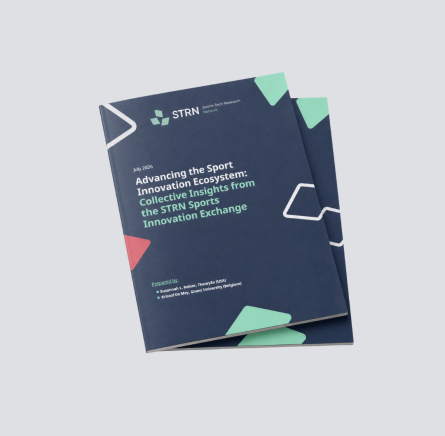
Collective Insights from the STRN Sports Innovation Exchange
This follow-up paper translates ecosystem theory into practice, synthesizing five key insights from our New York City Exchange to improve industry-wide decision-making:
- Problem-First Innovation: Define the need before the technology.
- Decision-Led Evidence: Match validation efforts to intended use levels.
- Adoption Capability: Focus on organizational readiness and behavior change.
- Ecosystem Learning: Leverage partnerships to accelerate shared knowledge.
- Radical Transparency: Build long-term credibility and stakeholder trust.
Next Steps: Manchester 2027
Join us in Manchester, UK (16-18 Feb 2027) for a 3-day event to turn these insights into action. Join the Innovation SIG to help shape the agenda.
Need
The sports technology sector is growing rapidly, driven by AI, Industry 5.0, and advances in human performance science. Yet innovation pathways across Academia, Elite Sport, and Commercial domains remain structurally fragmented.
Fragmented incentives and timelines, combined with structurally underdeveloped validation standards (though progress is emerging), create systemic inefficiencies and a persistent “valley of death” between prototype and scalable implementation.
A coordinated, system-level framework is required to enable sustainable, evidence-informed, and scalable innovation.
Objectives
Develop a Global Systems Perspective on the Ecosystem
Provide a helicopter-view analysis of how sports tech innovation currently operates across Academic, Elite Sport, and Commercial domains, highlighting structural dynamics and ecosystem fragmentation.
Clarify Stakeholder Roles and Ecosystem Drivers
Define the five core stakeholder groups and the key structural drivers required to strengthen innovation capacity, entrepreneurial translation, and long-term ecosystem resilience.
Enable Sustainable Translation and Scale
Propose practical mechanisms to bridge silos, de-risk early-stage innovation, and support long-term, cross-industry scalability.
Members
 Susie ReinerTheoryEx (USA)
 Pedro EstevesSPRINT (Portugal)
 Patrick Scott WelshInnervation Sciences (USA)
 Torstein Dalen-LorentsenSINTEF (Norway)
 Warren GregsonManchester Metropolitan University (UK)
 Kieran CollinsTU Dublin (Ireland)
 Kristof De MeyGhent University (Belgium)
